I went to see Awakening in Las Vegas without reading almost anything about it beforehand. I admit this was partly a strategic choice and partly sheer laziness. I had seen a few photos on Instagram — those bright, almost impossible images, with extravagant costumes, dramatic lighting, and bodies doing things that an ordinary person’s spine would never approve of without serious negotiation.
My first impression was simple: “This must be something vaguely circus-adjacent.” Juggling, acrobatics, smoke, people hanging from the ceiling, loud music, and an audience pretending it is perfectly normal to watch someone spin through the air as if gravity were merely a suggestion.
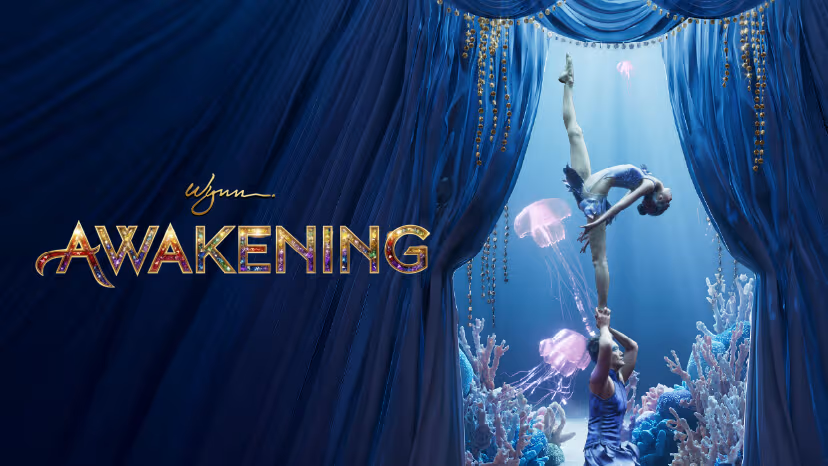
So I walked in with low expectations which, let’s be honest, is often an excellent way not to be disappointed. When you expect very little, anything remotely well done already feels like a gift. But Awakening didn’t win me over simply because the bar was low. It won me over because, within a few minutes, it became clear that this was not just a beautiful show, nor merely a luxurious circus variation for tired tourists who had already walked miles through hotel-casinos.
What happens there is an immersive, sensory experience. And yes, I know: “immersive” has become one of those words we now use for everything: immersive exhibitions, immersive dinners, immersive meetings; even online courses want to call themselves immersive these days. Most of the time, it simply means someone turned up the volume, dimmed the lights, and projected something onto a wall. But in the case of Awakening, the word actually earns its place. The circular stage, the closeness of the performers, the visual effects, the music, the creatures, the costumes, and the lighting all create the feeling that the audience is not merely watching a story. It is being swallowed by one.
The narrative itself is simple. Light and darkness. A character on a journey. Fantastic worlds. Obstacles. Opposing forces. Reunion. Transformation. Nothing that requires a seminar in hermeneutics or a footnote involving Freud, Jung, Bion, and three impossibly difficult French thinkers. The story is direct, almost childlike in the best sense of the word. Easy to follow, easy to understand, easy to feel.
And this is where an important point emerges: not every simple narrative is shallow. Sometimes simplicity is precisely what allows something older within us to come to the surface.
Light and darkness are basic images of human experience. They do not belong only to fairy tales, religions, myths, or fantasy films. They organize part of our inner life. We all carry illuminated zones, the ones we show with relative ease: our virtues, our good intentions, our civilized gestures, our carefully worded sentences, our best angles. But we also carry darker zones: fears, envy, aggression, resentment, contradictory desires, and thoughts we would rather not post anywhere.
What is interesting is that Awakening does not need to explain any of this. It shows it. And by showing it in such a grand, almost excessive way, it manages to touch something that no explanation could reach with the same force.
Las Vegas, by the way, is the perfect setting for this kind of experience. The entire city feels like a negotiation between light and darkness. Everything shines, everything blinks, everything calls out, everything promises. At the same time, behind all that visual excess, there is an obvious shadow: consumption, gambling, loneliness, artificiality, exhaustion, people trying to have fun with almost military discipline. Vegas is a city where the spectacle does not stay on the stage. It begins on the sidewalk, continues in the casino, follows you into the elevator, reaches the restaurant, and before you know it, even the ceiling is trying to sell you something.
In this context, Awakening makes perfect sense. It is not a show against Las Vegas. It is Las Vegas with a touch of mythology. Las Vegas dressed as a dream. Las Vegas trying to say: “Yes, everything here is artificial, but that does not mean it cannot produce some kind of truth.”
That is an uncomfortable idea. We tend to treat the artificial as if it were synonymous with the false. As if only what is natural could be legitimate, deep, or true. But anyone who has ever been moved by theater, cinema, literature, music, or a beautifully told lie knows that imagination does not need to be “real” in order to have real effects.
No one leaves Awakening literally believing they have witnessed a cosmic battle between light and darkness. No one, I hope. But something in that organized excess passes through the spectator. The giant creatures, the moving bodies, the light effects, the music, the sheer grandeur of the space, everything conspires, for a few moments, to suspend our adult obsession with control. And adults control far too much.
They control their schedules, their weight, their passwords, their credit cards, their reputation, their opinions, their screen time, the air-conditioning temperature, and even their spontaneity. Many people reach adulthood with their imagination domesticated. Fantasy becomes acceptable only when it serves some productive function: creativity to sell more, innovation to grow, storytelling to engage, visualization to hit a goal. Even dreams are expected to deliver results.
In that sense, Awakening has something provocative about it. It places us, tired adults, in front of a shameless, luxurious, slightly absurd fantasy, and forces us to face a simple question: when did imagining start to feel like a waste of time?
Because there is a kind of adult embarrassment in the face of fantasy. A child enters this kind of world without asking for permission. Children understand the pact quickly: it is not factual truth, but it is play-truth. And play-truth is a very serious category. Adults, on the other hand, keep trying to evaluate whether it is sophisticated, whether the ticket was worth it, whether the seat was good, whether the story had enough depth, whether the special effect was truly convincing. Adults buy the ticket and then fight against their own surrender.
Deep down, fantasy requires a form of humility. To enter it, we have to accept that not everything needs to be explained while it is happening. We have to suspend irony for a few minutes. We have to admit that we are still impressionable. And perhaps that is one of the great contemporary embarrassments: being impressionable. In a world where everyone needs to appear intelligent, critical, and immune to naïveté, allowing oneself to be enchanted has become almost a reputational risk.
But enchantment is not stupidity. Stupidity is mistaking cynicism for intelligence. Awakening works precisely because it does not apologize for being fantastical. It does not try to appear realistic, discreet, or overly profound. It embraces the delirium. And by embracing that delirium with technical mastery, it creates a curious space: we know it is an illusion, but we agree to be led by it. Not an illusion that deceives us, but one that organizes an experience.
Psychoanalysis, in a way, knows this territory well. Human life is not made only of facts. It is also made of fantasies, inner scenes, old fears, intimate characters, repetitions, images, and stories we tell about ourselves. Very often, what moves us is not exactly what happened, but the way it was registered within us. Psychic reality also has its stages, its monsters, its lights, and its smoke machines.
That is why the opposition between light and darkness in Awakening does not need to be read as childish morality: good on one side, evil on the other. That would be too poor a reading. What is more interesting is to think that light and darkness do not simply cancel each other out. They summon each other. Where there is light, a shadow appears. Where there is shadow, something asks to be translated. Our darker sides do not disappear when we pretend to be enlightened people. At best, they change clothes and sit with us at the table.
The show touches on this in a simple, visual, and accessible way. It does not go too deep, does not overcomplicate things, does not try to turn everything into a problem. Thankfully. Its job is not to replace analysis, a lecture, or a philosophy class. Its job is to open a sensory passage. And through that passage, each person takes in what they can.
Some will leave talking about the special effects. Others, about the costumes. Others, about the ticket price. There is always someone particularly skilled at returning from enchantment straight to the spreadsheet. Fair enough. But those who allow themselves to enter a little more deeply into the experience may realize that the “awakening” in the title is not exactly an awakening to reality. In a certain sense, it is an awakening to fantasy. That sounds contradictory, but it is not.
Sometimes, awakening does not mean giving up on dreams. It means recovering the ability to daydream without feeling ridiculous. It means remembering that imagination is not an ornament added to life, but one of its ways of breathing. Without imagination, life becomes excessively literal. And a life that is too literal may be efficient, organized, and even respectable, but it is often poor in wonder.
I left Awakening with this impression: the show did not offer me a great revelation about the human condition, nor a complex narrative about light and shadow. It offered something rarer than it seems: a well-crafted pause from adult disbelief. For a while, I did not have to decide whether what I was watching was deep or superficial, artistic or commercial, circus-like or theatrical, naïve or sophisticated. I could simply look.
Perhaps that is the true luxury of a show like Awakening: not the shine, not the technology, not the flawless effects, not the grandeur of the Wynn in Las Vegas. The greater luxury is allowing adults, for a few minutes, to agree to take part in a fantasy without apologizing for it.
In the end, light and darkness were on the stage, of course. But they were also in the audience, well dressed, ticket in hand, trying to remember how one goes about imagining.

Leave a Reply